How to Use a Gap Year to Build Skills and Direction in South Africa

A gap year is often framed as either a luxury or a failure. In reality, for many students in South Africa, it is neither. It is something that happens due to funding issues, missed application deadlines(I went through the same thing), academic setbacks, or family circumstances.
What matters is not whether you planned a gap year, but what you do with the time once it exists.
This guide looks at how a gap year can be used intentionally to build skills, clarity, and direction—without pretending it is easy or pressure-free. The goal is not to “figure out your whole life,” but to exit the year stronger than you entered it.
Understanding the Reality of a Gap Year in South Africa
For many students, a gap year is unintended. Some did not get into the course they wanted. Others were accepted but could not secure funding or accommodation. Some had to pause studies after failing modules or dealing with personal challenges.
In these situations, the biggest danger is not the gap year itself—it is drift(just flowing aimlessly).
Without structure, days blend into weeks, confidence drops, and anxiety grows. Social pressure makes things worse. Watching peers move forward while you feel stuck can create shame and paralysis.
A productive gap year does not require money, travel, or perfect planning. It requires structure(a routine), honesty(with yourself), and small consistent actions.
The Purpose of a Gap Year (What It Is—and Isn’t)
A gap year is not about:
- relaxing endlessly
- escaping responsibility
- proving something to others
It is also not about:
- grinding nonstop
- becoming rich quickly
- solving your entire future
A useful gap year is about:
- stabilising your life
- building practical skills
- learning how you work
- regaining confidence and momentum
Direction often comes after action, not before it.
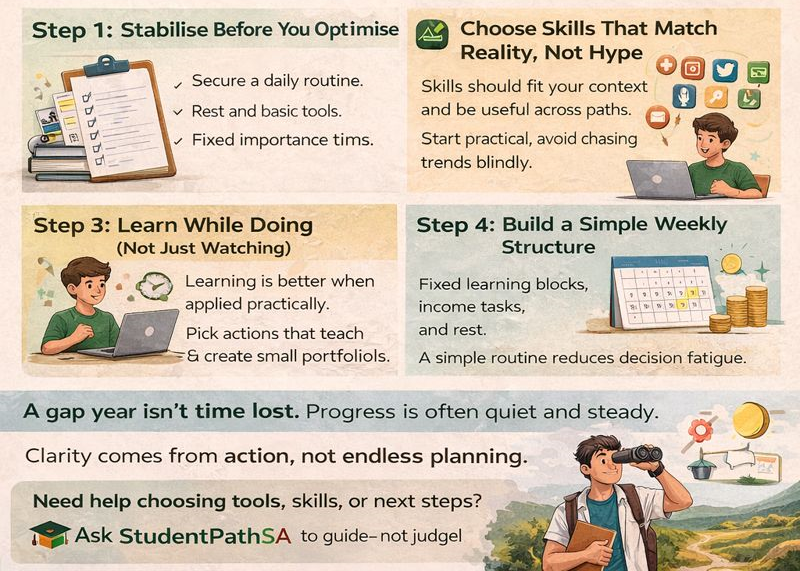
Step 1: Stabilise Before You Optimise
Before chasing skills or income, stabilise the basics.
Ask yourself:
- Do I have a predictable daily routine?
- Am I sleeping and eating consistently?
- Do I have access to basic tools (phone, data, laptop)?
- Am I avoiding decisions because I feel overwhelmed?
If you need tools to study or work during this period, avoid rushing into purchases. This guide on best laptops for students in South Africa explains how to choose something practical without overspending.
Stability creates the mental space required for progress.
Step 2: Choose Skills That Match Reality, Not Hype
During a gap year, skills should be:
- learnable with limited resources
- useful across multiple paths
- realistic within your context
Good examples include:
- clear writing and communication
- basic computer literacy and productivity tools
- spreadsheets and simple data handling
- tutoring or subject-based support
- entry-level digital skills
Avoid chasing skills purely because they are trending online. Many “high-income skills” require long runways and strong foundations. Start with skills that build confidence quickly.
Step 3: Learn While Doing (Not Just Watching)
Watching videos and saving resources feels productive but often leads to stagnation(Something i finally realised during my own gap year is that watching courses and not doing anything with them isn’t learning it’s you entertaining yourself).
A better approach to that is:
- learn a small concept
- apply it immediately
- repeat consistently
If you’re learning:
- writing → write weekly(Thats how this started)
- tutoring → tutor one learner
- Admin skills → help someone organise data
- digital tools → build something simple(build an app, build a podcast or even a website or blog)
This approach builds both skill and evidence.
If income is necessary, this guide on ways students can make money while studying in South Africa outlines options that fit around learning and do not require sacrificing long-term progress.
Step 4: Build a Simple Weekly Structure
A gap year without structure quickly becomes stressful.
A simple weekly framework might include:
- Waking up at the same time
- learning blocks (2–4 hours a day)
- income or responsibility blocks
- movement or physical activity(a walk or even a simple workout)
- rest without guilt
Structure reduces decision fatigue and restores a sense of control.
Consistency matters more than intensity. This guide on how to stay consistent without burning out explains how to protect momentum without exhausting yourself.
Step 5: Use the Gap Year to Test, Not Commit
You do not need to decide your entire future during a gap year.
Instead, use the time to test:
- fields you’re curious about
- work environments you tolerate or dislike
- study styles that work for you
- levels of independence you can handle
Testing replaces anxiety with information.
A gap year used this way often leads to better academic choices, not delays.
Step 6: Prepare for Re-entry (Study, Work, or Both)
As the year progresses, shift focus toward what comes next.
This might include:
- reapplying to university or college
- changing fields based on experience
- entering vocational or skills-based routes
- combining part-time study with work
Document what you’ve learned. Skills, routines, and experiences matter more than perfect timelines.
For a broader framework that connects discipline, tools, academics, and life management, the student survival guide in South Africa brings these pieces together.
A Gap Year Is Not Time Lost
A gap year only becomes wasted when it is treated as something to endure rather than shape.
Progress during this time is often quiet it’s:
- better habits
- clearer thinking
- stronger resilience
- practical skills
These do not show immediately, but they compound.
Many students return from gap years more focused, disciplined, and prepared than those who rushed forward without stability.
My Final Thoughts: Direction Comes From Movement
If you are on a gap year, you are not behind—you are between phases.
Start small.
Move consistently.
Adjust as you learn.
Direction will follow.
If you need help choosing tools, skills, or next steps, StudentPathSA exists to guide—not judge.
your can send us an email with your questions on hello@studentpathsa.co.za