How to Reapply to University Without Losing Momentum

Reapplying to university is rarely talked about honestly. It’s often framed as starting over, falling behind, or fixing a mistake. In reality, for many students in South Africa, reapplying is a necessary reset, not a failure.
Students reapply for many reasons: funding challenges, missed deadlines, rejection from competitive programmes, academic setbacks, or changes in personal circumstances. What matters is not why you are reapplying, but how you move through the process without losing direction or confidence.
This guide explains how to reapply to university in a way that protects your momentum, your mental health, and your future options.
Understanding Why Reapplication Happens
Reapplication is more common than people admit. Many successful graduates did not enter university smoothly on their first attempt.
Some students:
- were accepted but could not secure funding or accommodation
- applied late or incomplete
- underestimated the academic demands of a programme
- faced family or health challenges
- changed their minds about what they wanted to study
None of these automatically reflect lack of ability or potential. They reflect context.
The danger is not reapplying. The danger is internalising the setback as a permanent label.
Reapplying Is a Process, Not a Pause
One of the biggest mistakes students make after an unsuccessful application cycle is treating the waiting period as dead time.
Reapplication works best when it is treated as an active phase, not a gap filled with anxiety. Momentum does not come from acceptance letters—it comes from daily actions that keep you engaged with learning and growth.
This is why many students use this period similarly to a gap year. If that’s your situation, this guide on how to use a gap year to build skills and direction explains how to structure the time intentionally.
Step 1: Get Clear on What Went Wrong (Without Blame)
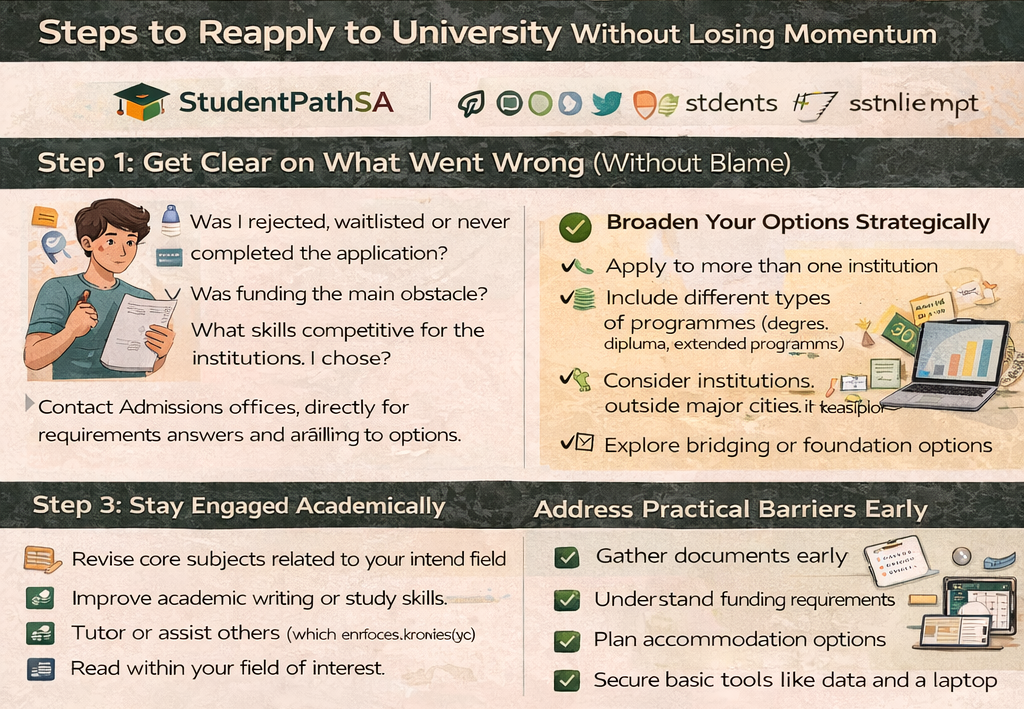
Before reapplying, you need clarity—not guilt.
Ask yourself the following:
- Was I rejected, waitlisted, or never completed the application?
- Was funding the main obstacle?
- Did I apply for the right programmes?
- Were my results competitive for the institutions I chose?
This is not about self-criticism. It’s about diagnosis. You can’t adjust what you don’t understand.
If needed, contact institutions directly. Admissions offices can often explain requirements, timelines, and realistic options better than assumptions or hearsay.
Step 2: Broaden Your Options Strategically
Many students reapply by submitting the same applications to the same institutions and hoping for a different outcome.
A better approach is strategic broadening:
- apply to more than one institution
- include different types of programmes (degree, diploma, extended programmes)
- consider institutions outside major cities if feasible
- explore bridging or foundation options
This is not “settling or giving up” It is creating paths.
Starting somewhere is often more powerful than waiting indefinitely for one ideal option.
Step 3: Stay Academically and Mentally Engaged
Losing momentum during reapplication usually happens when students disconnect from learning completely.
You don’t need to study full-time, but you should stay engaged:
- revise core subjects related to your intended field
- improve academic writing or study skills
- tutor or assist others (which reinforces knowledge)
- read within your field of interest
Staying mentally active makes re-entry easier and reduces the shock of returning to formal study.
Step 4: Address Practical Barriers Early
Many reapplications fail not because of academic issues, but because of logistics.
Use this time to:
- gather documents early
- understand funding requirements
- plan accommodation options
- prepare access to basic tools like data and a laptop
If access to equipment is a challenge, this guide on best laptops for students in South Africa explains how to choose practical options without overspending, including refurbished and leasing alternatives.
Removing friction early protects your energy later.
Step 5: Manage Money Without Undermining Your Goals
For some students, reapplication periods require working to survive. That reality should be acknowledged honestly.
The key is choosing work that does not destroy your academic readiness. Overworking may help short-term finances but delay long-term progress.
This guide on ways students can make money while studying in South Africa explains income options that fit around learning rather than replacing it.
Momentum is fragile. Protect it.
Step 6: Keep a Weekly Structure (Even Without Classes)
One of the fastest ways to lose direction is to abandon routine completely.
A simple weekly structure might include:
- fixed wake-up times
- learning or preparation blocks
- application-related tasks
- income or responsibility blocks
- rest that is intentional, not avoidant
Structure creates dignity. It reminds you that you are still moving forward, even if the timeline looks different from others.
If consistency feels difficult, this guide on how to stay consistent without burning out explains how to build systems that don’t rely on constant motivation.
Reapplication Is Not a Step Back
Reapplying does not erase your effort, intelligence, or future potential. Many students who reapply enter university more prepared, disciplined, and resilient than those who rushed in without stability.
What matters most is not disappearing during the waiting period.
Progress during reapplication often looks quiet:
- better habits
- clearer goals
- stronger systems
- improved self-awareness
These gains compound.
My Final Thought: Momentum Is a Choice You Renew Daily
You cannot control admissions timelines, funding outcomes, or institutional capacity. You can control how you use the time in between.
Reapplication does not define you.
How you respond to it does.
If you need guidance during this phase—applications, tools, structure, or next steps—StudentPathSA exists to support, not judge.
your can send us an email with your questions on hello@studentpathsa.co.za