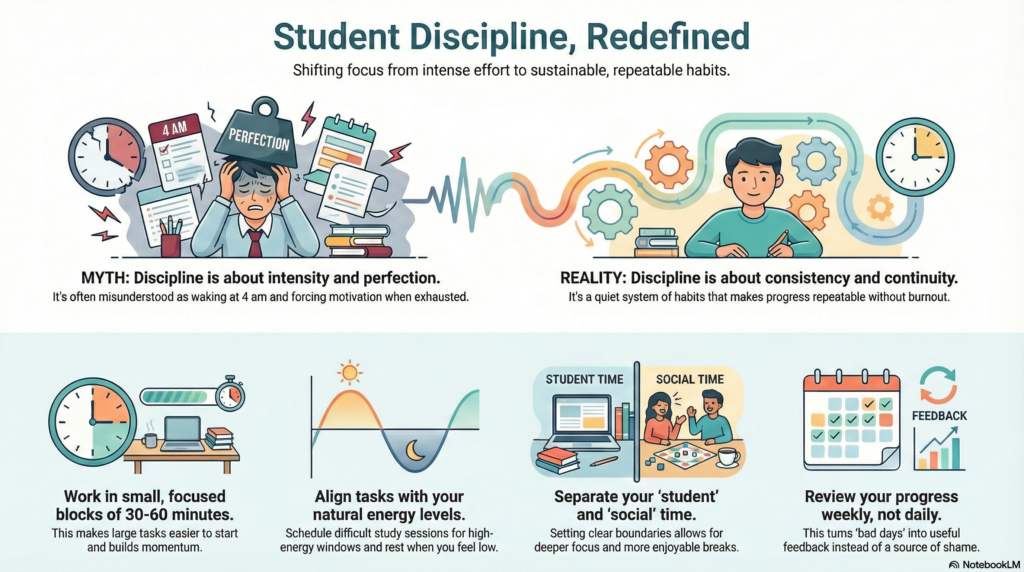
Discipline is often misunderstood. Students are told it means waking up at 4am, cutting off all social life, or forcing motivation when energy is already depleted.
That version of discipline rarely works for students — especially in South Africa, where academic pressure, financial stress, and limited resources are part of daily reality.
Real discipline is quieter. It’s not about intensity or perfection. It’s about habits that reduce friction, protect energy, and make progress repeatable.
This guide focuses on discipline habits that actually help students stay registered, submit work, and finish what they started — without burning out.
Why Most Discipline Advice Fails Students
Most discipline advice is borrowed from environments students don’t live in:
- people with full control over their time
- stable finances
- quiet workspaces
- predictable routines
Students, on the other hand, deal with:
- overlapping deadlines
- shared living spaces
- part-time work
- inconsistent energy
When advice ignores context, discipline feels like failure instead of support.
Effective discipline adapts to reality instead of fighting it.
Habit 1: Show Up First, Worry About Performance Later
One of the most powerful discipline habits is attendance.
Not perfect focus.
Not full understanding.
Just showing up.
Attending lectures, opening the document, sitting down to study — even when motivation is low — keeps you connected to the academic system.
Showing up prevents:
- falling completely behind
- anxiety spirals
- unnecessary catching up
Consistency begins with presence, not excellence.
Habit 2: Work in Small, Non-Negotiable Blocks
Students often fail at discipline because tasks feel too large.
Instead of planning long study sessions, commit to:
- 30–60 minute focused blocks
- one module at a time
- one clear task per block
Small blocks are easier to start and easier to repeat.
This habit is especially useful when things already feel overwhelming. If structure has collapsed, this guide on how to regain structure when everything feels messy as a student helps stabilise things before pushing further.
Habit 3: Protect the Start of Tasks, Not the Finish
Many students wait for “enough time” before starting work. That time rarely appears.
Discipline improves when you:
- start assignments early
- open work even if you don’t finish
- remove pressure to complete everything in one sitting
Starting reduces mental load. Finishing becomes easier later.
The habit is not finishing fast — it’s starting without fear.
Habit 4: Build Discipline Around Energy, Not Motivation
Motivation fluctuates. Energy patterns are more predictable.
Pay attention to:
- when you focus best
- when you crash
- when socialising drains you
- when studying feels easiest
Then align discipline to energy:
- study during high-energy windows
- rest during low-energy periods
- avoid heavy tasks when exhausted
Discipline that ignores energy creates burnout. Discipline that respects it creates longevity.
If burnout is already present, learning how to stay consistent without burning out is more important than pushing harder.
Habit 5: Separate “Student You” From “Social You”
Blurred boundaries weaken discipline.
When studying and socialising overlap constantly, both suffer.
A simple habit:
- when studying → phone away, social notifications off
- when socialising → no guilt about work
This separation allows:
- deeper focus
- more enjoyable breaks
- fewer internal arguments
Discipline is often just clear boundaries, not restriction.
Habit 6: Review Weekly, Not Constantly
Students often judge themselves daily:
- “I wasted today.”
- “I didn’t do enough.”
- “I’m behind again.”
Daily self-judgment destroys discipline.
A better habit:
- review once a week
- adjust plans calmly
- focus on trends, not bad days
Weekly reviews turn mistakes into feedback instead of shame.
Tools and Items That Support Student Discipline
Discipline is easier when your environment supports it. Tools don’t replace habits, but they remove unnecessary resistance.
1️⃣ A Reliable Notebook or Planner
- for deadlines
- weekly priorities
- simple planning
Digital or physical — consistency matters more than format.
If you’re unsure whether a physical planner or a simple digital system works better for you, this guide on student planning tools and study organisation breaks down practical options without overcomplicating things.
2️⃣ A Functional Laptop (Not the Best One)
Students don’t need top-tier devices. They need reliability.
A laptop that:
- turns quickly
- handles documents and research
- Can use basic apps like Microsoft Word,Excel and others
- doesn’t crash during assignments
reduces frustration and procrastination.
If you’re unsure what’s practical, this guide on best laptops for students in South Africa explains how to choose without overspending, including refurbished and leasing options.
3️⃣ Noise Control Tools
Shared spaces drain focus.
Helpful items:
- earphones or headphones
- white noise or instrumental music
- quiet campus spaces
Reducing noise is a discipline shortcut.
If shared spaces are a constant challenge, this guide on affordable focus and noise-control tools for students explores simple options that help without requiring expensive equipment.
4️⃣ Simple Digital Tools (Not Too Many)
Too many apps create distraction.
Useful basics:
- Google Calendar (deadlines + exams)
- Google Docs / Word
- one task list (digital or paper)
Discipline improves when tools are few and familiar.
If you feel overwhelmed by apps and systems, this guide on simple digital tools for students explains how to choose only what you’ll actually use and ignore the rest.
5️⃣ A Dedicated Study Spot
It doesn’t need to be perfect.
It needs to be:
- predictable
- associated with work
- free from constant interruption
Your brain learns faster when spaces have meaning.
For students working with limited space or shared accommodation, this guide on setting up a functional study space as a student shows how to create focus with what you already have.
Discipline Is About Staying in the System
Students often think discipline means excellence. In reality, it means continuity.
Discipline keeps you:
- registered
- submitting
- attending
- progressing
Perfection is optional. Continuity is not.
For a broader framework that connects discipline, tools, campus life, and survival, the student survival guide in South Africa brings everything together and don’t forget tools don’t create discipline on their own, but the right tools remove unnecessary resistance. Choosing what supports your habits — and ignoring the rest — is part of staying consistent as a student.
Final Thought: Discipline Should Make Life Easier, Not Smaller
Good discipline:
- reduces anxiety
- protects your future
- creates space for rest
- supports enjoyment of campus life
If your version of discipline feels like punishment, it’s probably unsustainable.
Build habits that work with your reality, not against it.
That’s how students finish degrees.