
How to Regain Structure When Everything Feels Messy as a Student
When things start falling apart during the semester, most advice feels disconnected from reality. You’re told to “just manage your time better,” “push through,” or “be disciplined,” as if pressure disappears on command.
For many students in South Africa who are already registered and attending classes, messiness is not caused by laziness or lack of ambition. It’s caused by overlapping deadlines, financial stress, family responsibilities, academic pressure, and the slow accumulation of burnout.
This article is for students who feel like their structure is slipping. Not a full reset. Not a perfect routine. Just a way to stabilise your studies and your life enough to keep going.
Why Things Fall Apart During the Semester
Academic life provides structure on paper: timetables, modules, deadlines, and calendars. But structure often collapses in practice when pressure increases faster than your systems can handle.
This usually happens when:
- multiple assignments and tests overlap
- lectures continue even when you’re mentally exhausted
- financial pressure forces you to juggle responsibilities
- personal or family issues spill into academic time
- rest keeps getting postponed “until things calm down”
When structure weakens, anxiety fills the gap. Days blur together. You feel busy but unproductive. Important tasks get delayed, not because you don’t care, but because everything feels heavy at once.
The problem is not effort. It’s the loss of containment.
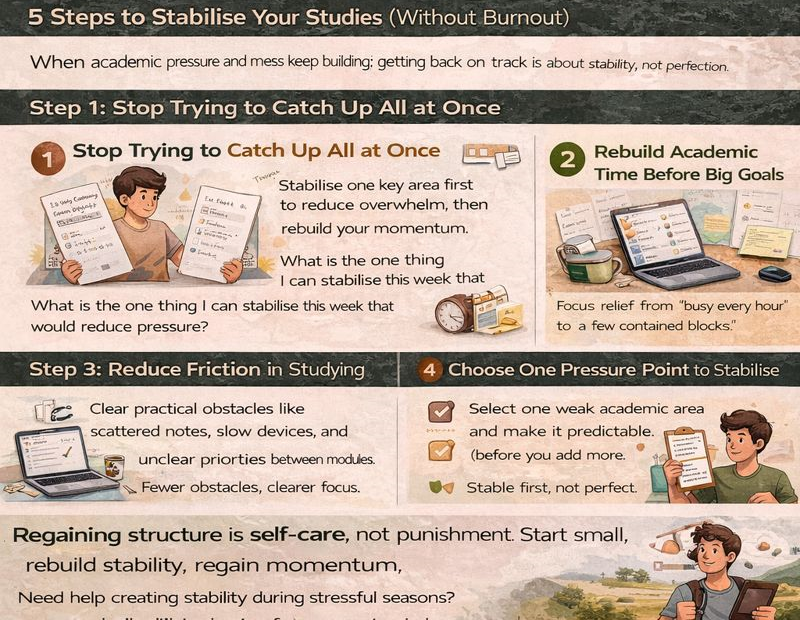
Step 1: Stop Trying to Catch Up All at Once
When you fall behind, the instinct is to fix everything immediately. This usually makes things worse.
Trying to catch up on all lectures, all readings, and all missed work at once overwhelms your nervous system. Overwhelm leads to avoidance, and avoidance creates more mess. This is often the early stage of burnout, and learning how to stay consistent without burning out can help prevent things from collapsing further.
Instead of asking:
“How do I fix everything?”
Ask yourself:
“What is the one thing I can stabilise this week that would reduce pressure?”
That might be:
- attending all lectures for one module
- finishing one overdue assignment properly
- rebuilding a sleep routine
- clearing one academic backlog
Stability creates space. Space allows momentum.
Step 2: Rebuild Academic Time Before Big Goals
When things feel messy, long-term goals stop helping. What matters first is time containment.
Before worrying about performance or outcomes, decide:
- when you will wake up
- when academic work happens
- when rest is allowed
A simple student-friendly rhythm might look like:
- Morning: lectures or revision
- Midday: one focused academic block
- Afternoon: admin, group work, or part-time responsibilities
- Evening: rest, light consolidation, wind-down
This is not a productivity system. It’s a way to stop academic pressure from leaking into every hour of your day.
Step 3: Reduce Friction in Studying
Consistency breaks down when studying requires too much effort before learning even begins.
Common friction points for students include:
- slow or unreliable devices
- unstable internet or data stress
- scattered notes across platforms
- unclear priorities between modules
- studying in distracting environments
You don’t need perfect conditions. You need fewer obstacles.
One place for notes.
One reliable device.
One clear next task.
Structure grows where resistance is low.
Step 4: Choose One Academic Pressure Point to Stabilise
Trying to improve everything at once leads to burnout.
Choose one academic pressure point:
- attendance and catching up
- assignment completion
- test or exam preparation
- time management
- rest and recovery
Make that one area predictable, not perfect.
When one part of your academic life stabilises, the rest becomes easier to manage. Momentum spreads sideways.
If financial pressure is part of what’s destabilising your studies, choosing income options that don’t overload you matters. This guide on ways students can make money while studying in South Africa explains safer, more realistic options.
Step 5: Use Weekly Resets Instead of Daily Perfection
Mess builds quietly when there is no reset point.
Once a week, pause and:
- review what actually happened
- clear or reorganise your study space (even partially)
- plan only the next 7 days
- choose 1–2 academic priorities
Consistency is not about doing everything right every day. It’s about correcting course regularly before things collapse.
When Academic Messiness Is Not a Personal Failure
It’s important to say this clearly: some messiness is structural, not personal.
Overloaded timetables, under-resourced environments, financial pressure, and family responsibilities cannot be solved with better planners or motivation alone.
In these situations, structure becomes a form of self-protection.
You are not behind because you are disorganised. You are responding to pressure.
Regaining Structure Is an Act of Care, Not Control
Structure is not about forcing productivity. It is about protecting your energy, focus, and mental health so you can continue.
You don’t need a perfect routine.
You don’t need to feel motivated.
You need enough structure to attend, submit, and recover.
That is how progress continues.
Let us leave you with this
When everything feels messy during the semester, the goal is not to become highly motivated again.
The goal is to feel contained enough to function.
Once you feel contained, action becomes possible.
Once action becomes possible, confidence slowly returns.
That is how students make it through difficult academic seasons.
For a broader framework that connects academics, discipline, tools, and student life realities, this student survival guide in South Africa brings everything together.


Pingback: How to Balance Campus Life and Discipline
Pingback: Discipline Habits That Actually Help Students
Pingback: The Ultimate Student Survival Guide in South Africa - studentpathsa.co.za